---
title: "Lightroom System Requirements 2026: RAM, GPU & Apple Silicon"
description: Lightroom Classic needs 16GB RAM, 4GB GPU & SSD. Full 2026 specs for Mac, Windows & Apple Silicon — plus a cloud alternative that skips hardware limits.
image: https://filterpixel.com/hubfs/Blog%20graphics%20-png.png
---
[Skip to content](https://filterpixel.com/blog/ultimate-guide-to-lightroom-system-requirements#main-content)
[](https://filterpixel.com/)
[Start for free Start for free](https://accounts.filterpixel.com/)
- [Culling](https://filterpixel.com/culling)
- [Editing](https://filterpixel.com/editing)
- [Pricing](https://filterpixel.com/pricing)
- Learn
Show submenu for Learn
- [How to use Filterpixel](https://filterpixel.com/blog/how-to-use-filterpixel-the-complete-feature-walkthrough)
- Help & Support
Show submenu for Help & Support
- [Live Customer Support](https://filterpixel.crisp.help/en/)
- [Community Support](https://www.facebook.com/groups/308582506851776)
- Guides
Show submenu for Guides
- [Event Photography Workflow](https://filterpixel.com/event-photography-workflow)
- [Conference Photography Workflow](https://filterpixel.com/conference-photography)
- [Sports Photography Workflow](https://filterpixel.com/sports-photography-workflow)
- Comparison
Show submenu for Comparison
- [Best Photo Culling Software 2026](https://filterpixel.com/best-ai-photo-culling-software)
- [FilterPixel vs Aftershoot](https://filterpixel.com/filterpixel-vs-aftershoot)
- [FilterPixel vs Narrative Select](https://filterpixel.com/filterpixel-vs-narrative-select)
- [FilterPixel vs Lightroom AI Culling](https://filterpixel.com/lightroom-ai-vs-filterpixel)
- [Imagen-AI Alternatives](https://filterpixel.com/imagen-ai-pricing)
- [PhotoMechanic Alternative](https://filterpixel.com/photo-mechanic-alternative)
- [Culling](https://filterpixel.com/culling)
- [Editing](https://filterpixel.com/editing)
- [Pricing](https://filterpixel.com/pricing)
- Learn
Show submenu for Learn
- [How to use Filterpixel](https://filterpixel.com/blog/how-to-use-filterpixel-the-complete-feature-walkthrough)
- Help & Support
Show submenu for Help & Support
- [Live Customer Support](https://filterpixel.crisp.help/en/)
- [Community Support](https://www.facebook.com/groups/308582506851776)
- Guides
Show submenu for Guides
- [Event Photography Workflow](https://filterpixel.com/event-photography-workflow)
- [Conference Photography Workflow](https://filterpixel.com/conference-photography)
- [Sports Photography Workflow](https://filterpixel.com/sports-photography-workflow)
- Comparison
Show submenu for Comparison
- [Best Photo Culling Software 2026](https://filterpixel.com/best-ai-photo-culling-software)
- [FilterPixel vs Aftershoot](https://filterpixel.com/filterpixel-vs-aftershoot)
- [FilterPixel vs Narrative Select](https://filterpixel.com/filterpixel-vs-narrative-select)
- [FilterPixel vs Lightroom AI Culling](https://filterpixel.com/lightroom-ai-vs-filterpixel)
- [Imagen-AI Alternatives](https://filterpixel.com/imagen-ai-pricing)
- [PhotoMechanic Alternative](https://filterpixel.com/photo-mechanic-alternative)
[Photography Workflow](https://filterpixel.com/blog/tag/photography-workflow) [Lightroom Alternative](https://filterpixel.com/blog/tag/lightroom-alternative) [Lightroom Alternatives](https://filterpixel.com/blog/tag/lightroom-alternatives) [Action: Major Refresh](https://filterpixel.com/blog/tag/action-major-refresh) 14 min read
# Lightroom System Requirements 2026: Complete Guide + Apple Silicon Benchmarks
Written by
[Rupsa Sarkar](https://filterpixel.com/blog/author/rupsa-sarkar)
Published on
21 Apr 2025
 Copy Link
[](https://twitter.com/intent/tweet?url=https://filterpixel.com/blog/ultimate-guide-to-lightroom-system-requirements) [](https://www.facebook.com/sharer/sharer.php?u=https://filterpixel.com/blog/ultimate-guide-to-lightroom-system-requirements) [](https://www.linkedin.com/sharing/share-offsite/?url=https://filterpixel.com/blog/ultimate-guide-to-lightroom-system-requirements)
When you're knee-deep in wedding photos and the deadline is looming, the last thing you want is your computer holding you back. Whether you're a seasoned pro or a rising photographer, having the [right setup](https://www.quora.com/Should-I-buy-a-laptop-for-editing-photos-or-can-I-edit-from-a-mobile-like-a-laptop) is essential to keep Lightroom running smoothly.
Let’s break down the Lightroom system requirements, explore budget-friendly graphics cards, and help you build the best desktop computer for photo editing—and then we’ll share an alternative to speed things up even further.
Shot thousands of photos?
FilterPixel culls them in minutes using genre-specific AI. Try DeepCull free.
[Try DeepCull Free →](https://filterpixel.com/deepcull)
## Why System Requirements Matter for Lightroom
[Photo editing isn’t just about creativity—it’s about efficiency too](https://filterpixel.com/blog/filterpixel-editing-profiles). Editing hundreds (or thousands) of high-res RAW files requires computing power that goes beyond your average office setup.
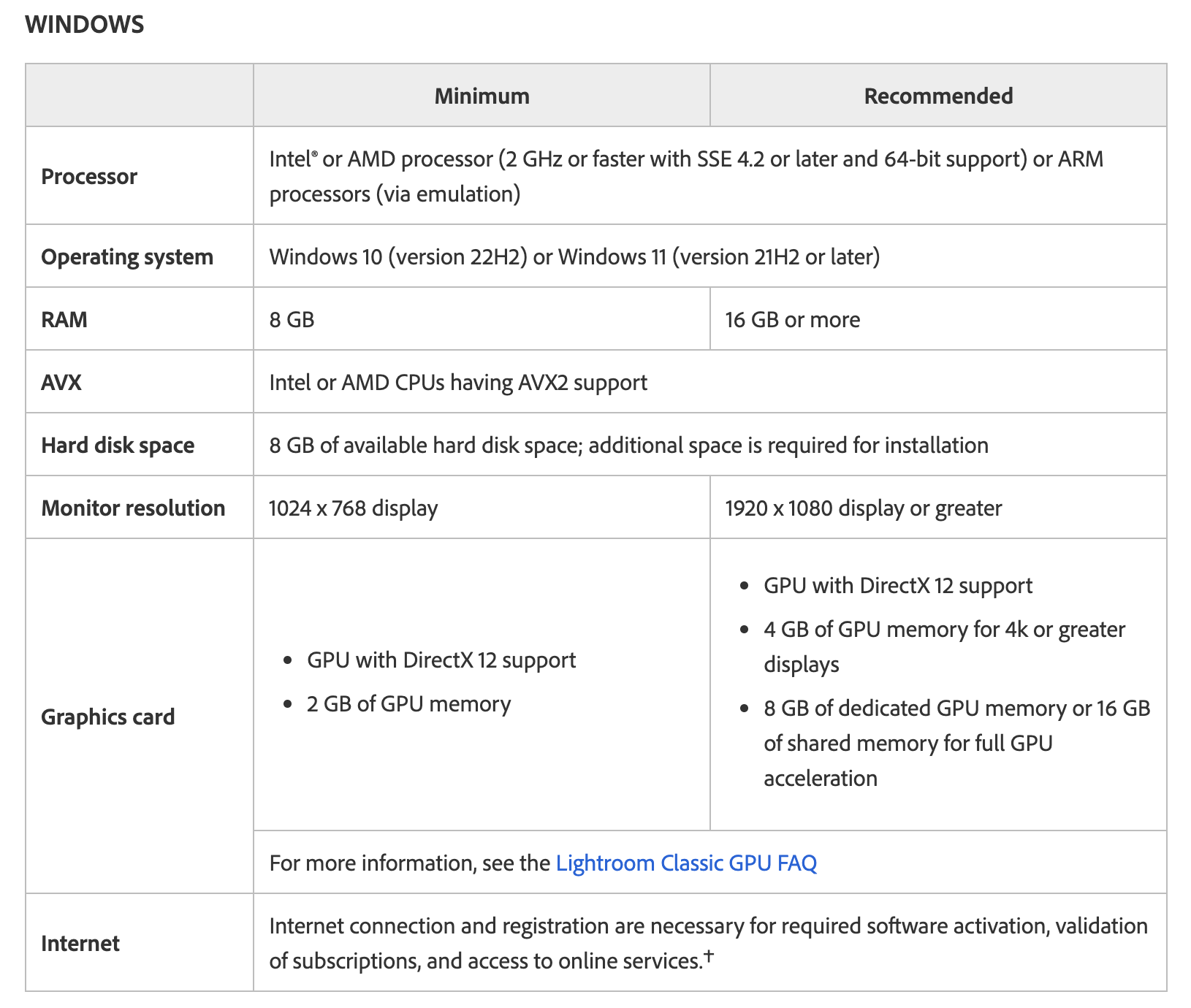
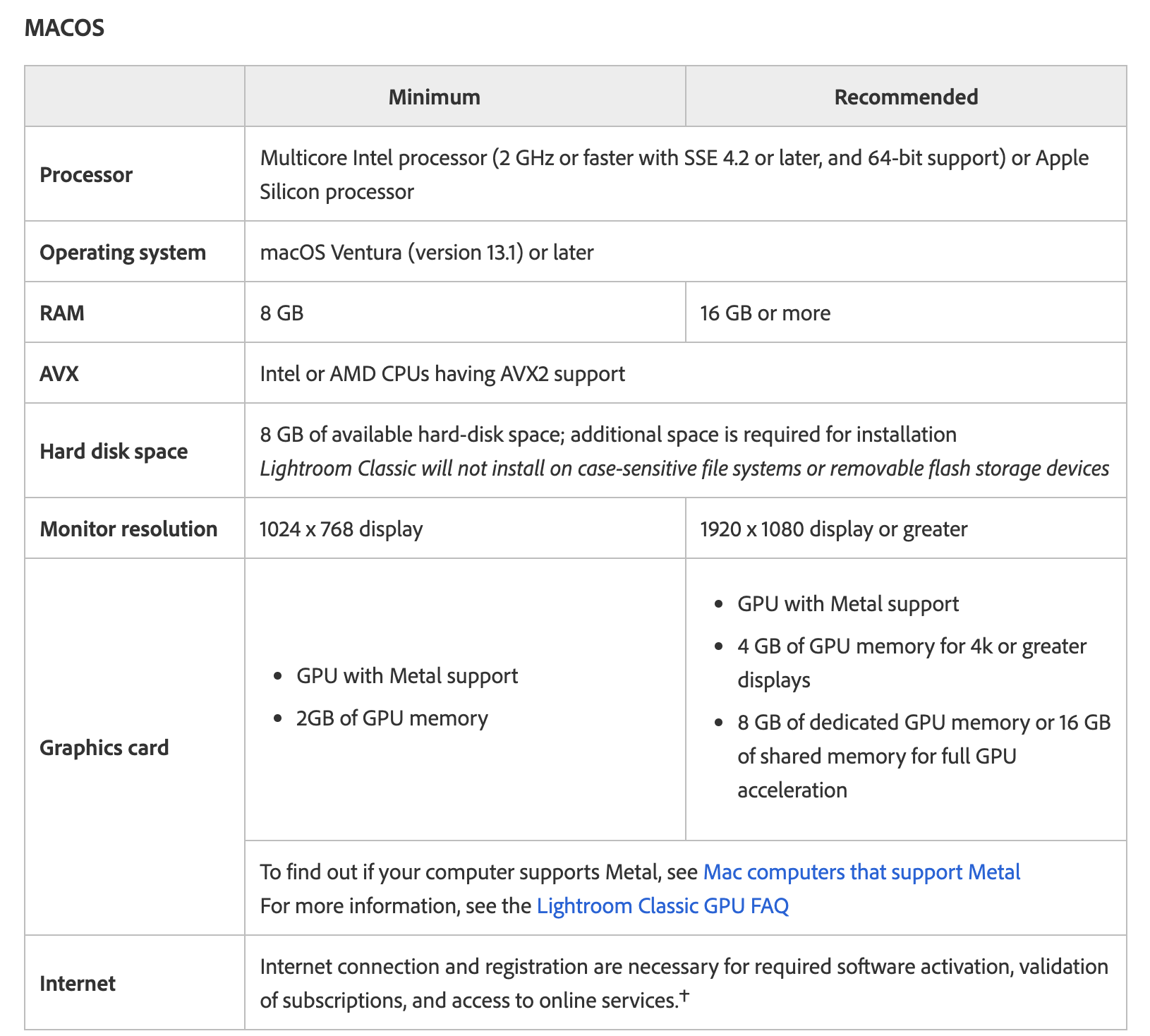
According to Adobe’s official specs:
- **Minimum Processor**: Intel or AMD with 64-bit support, 2 GHz or faster
- **Recommended Processor**: Intel Core i5 or better (3 GHz+ for smoother performance)
- **Minimum RAM**: 8 GB
- **Recommended RAM**: 16 GB (or 32 GB for serious multitasking)
- **Graphics Card (GPU)**: GPU with DirectX 12 support and at least 2GB of VRAM (4GB+ for 4K displays)
- **Hard Drive**: 2GB available space for installation, SSD recommended
- **Display**: 1280 x 800 minimum, 1920 x 1080+ preferred
Source:[Adobe Help Center](https://helpx.adobe.com/lightroom-classic/system-requirements.html)
[](https://helpx.adobe.com/lightroom-classic/system-requirements.html)
[](https://helpx.adobe.com/lightroom-classic/system-requirements.html)
## Laptop vs. Desktop for Photo Editing
While Lightroom is available on mobile and tablet, pros need something more powerful. Here's a quick breakdown:
#### **Laptop**
- Pros: Portability, on-the-go editing, easier client presentations
- Cons: Higher cost for performance, limited upgrade options, may throttle under load
#### **Desktop**
- Pros: Better performance for the price, easier to upgrade, improved cooling, ideal for long sessions
- Cons: Less portable, takes up more space
Verdict: If bulk editing and AI processing are part of your workflow, go desktop.
## Budget Graphics Card for Photo Editing
You don’t need a top-tier gaming GPU to edit photos. Instead, look for a card that supports GPU acceleration (for faster zooming, scrolling, and rendering previews). Great budget options (under ₹15,000 / $200):
- NVIDIA GTX 1650 Super
- AMD Radeon RX 6500 XT
- Intel Arc A380 (emerging budget option)
These GPUs won’t speed up core Lightroom exports drastically, but they’ll boost responsiveness and smooth navigation.
## GPU Requirements: What Actually Matters
Lightroom Classic uses GPU acceleration for:
- **Image rendering** — zooming, scrolling, and previewing in Develop module
- **AI Denoise** — the most GPU-intensive Lightroom feature
- **AI Masking** — subject, sky, and background detection
- **Lens Blur** — the depth-aware blur feature
**Minimum GPU VRAM by use case:**
| Use Case | Min VRAM | Recommended VRAM |
| --- | --- | --- |
| Basic editing (1080p display) | 2 GB | 4 GB |
| 4K display editing | 4 GB | 6 GB |
| AI Denoise (heavy use) | 4 GB | 8 GB |
| Dual 4K monitors + AI features | 6 GB | 8-12 GB |
## How Much RAM Is Enough?
Lightroom runs fine on 8GB—but add a few plugins, background tasks, or open Chrome tabs, and you’ll quickly run into bottlenecks.
Recommended for photographers:
- 16GB minimum for Lightroom Classic and culling apps
- 32GB if you run Photoshop, editing plugins, and Chrome at once
## Apple Silicon Performance for Lightroom
If you're on a Mac, Apple Silicon chips have transformed Lightroom performance. Here's how they compare:
| Chip | Cores | RAM | LR Classic Export (100 RAW) | AI Denoise Speed |
| --- | --- | --- | --- | --- |
| M1 | 8 | 8–16 GB | ~3 min 20s | ~25s per image |
| M2 | 8 | 8–24 GB | ~2 min 50s | ~20s per image |
| M3 Pro | 12 | 18–36 GB | ~2 min 10s | ~14s per image |
| M3 Max | 16 | 36–128 GB | ~1 min 40s | ~9s per image |
| M4 Pro | 14 | 24–48 GB | ~1 min 30s | ~7s per image |
**Key takeaway:** Any M-series Mac handles Lightroom Classic well. The M3 Pro or M4 Pro are the sweet spot for professional photographers who process 1,000+ images per shoot.
Apple Silicon's unified memory architecture means the GPU shares system RAM — so 16 GB unified memory on an M2 actually outperforms many 16 GB + 4 GB VRAM Intel setups for Lightroom tasks.
## Best Photo Editing Desktop Configuration (2026 Edition)
If you’re building or buying a new photo editing desktop computer for post-production, aim for:
- CPU: AMD Ryzen 7 7800X3D or Intel i7-14700K
- RAM: 32GB DDR5 (Corsair or G.Skill recommended)
- Storage: 1TB SSD + 2TB HDD (for long-term storage)
- GPU: NVIDIA RTX 4060 / RTX 4070 / AMD Radeon RX 7600
- Monitor: IPS 4K display (BenQ, Dell Ultrasharp, or ASUS ProArt)
According to Puget Systems, Lightroom performance increases 20-30% when shifting from 8 to 16 cores, and over 40% with SSD over HDD.
## Can You Edit Videos in Lightroom?
Yes, Lightroom Classic allows basic video trimming and adjustments (like exposure, contrast), but it’s not meant for full-fledged video editing. For serious work, use Adobe Premiere Pro, DaVinci Resolve, or Final Cut Pro.
## What Slows Lightroom Down?
- Too many background apps
- Using HDD instead of SSD
- Not enough RAM or old CPU
- Outdated GPU drivers
- Catalogs stored on external slow drives
## Tired of Lightroom Being Slow?
If you’re spending more time waiting than creating, it’s time to look beyond just hardware. Try software that’s designed to [automate photo culling and bulk editing](https://filterpixel.com/ai-photo-culling-software).
## Meet FilterPixel — A Faster Alternative to Lightroom Bulk Editing
-png.png?width=1920&height=960&name=Blog%20graphics%20%20(1)-png.png)
[FilterPixel](https://filterpixel.com/) is built for professional photographers who want to:
- Auto-cull thousands of images using AI (95% accuracy)
- Detect blur, closed eyes, and duplicates
- Instantly preview, review, and export only the best
- Save8+ hours per shoot
Used by 10,000+ photographers and backed by Google and NVIDIA Inception, FilterPixel can run on modest machines and doesn’t require heavy GPUs or RAM to deliver powerful results.
📌 Start your free trial at[filterpixel.com](https://filterpixel.com/) and see the difference yourself.
###### COMMUNITY TRUST
## Join Over 1000 Satisfied Photographers Worldwide
Become part of a global community that trusts FilterPixel for its accuracy and efficiency in transforming their photography workflows.
### Dominic & Ruby
Wedding Photographer, UK
#### “FilterPixel gives us our lives back.”
We take around 20K photos at a wedding and, now we can edit them faster and our clients can get their photos faster.
It doesn't take away any creative control, we have trained it on our photos & it edits as per our style.
### Bonnie Blu
Wedding Photographer, Atlanta
#### “Now I can deliver weddings in one day rather than months”
It saves me days that I can spend with my son and, at the same time, deliver galleries much faster to my clients.
The best thing about FilterPixel is that it learns your preferences as you use it.
### Shinu John
Portrait Photographer, Dublin
#### “It's an irreplaceable tool for photographers”
For culling 500 photos manually, It would take me an hour but Filterpixel does this barely in minutes.
It saves so much time & money and is irreplaceable
[Try FilterPixel for free](https://accounts.filterpixel.com/)
Related Reading
- [Best Photo Culling Software 2026: 6 Tools Compared](https://filterpixel.com/best-photo-culling-software)
- [Free Photo Culling Software — No Credit Card Needed](https://filterpixel.com/free-photo-culling-software)
- [What Is Photo Culling? Definition, Methods & AI Tools](https://filterpixel.com/what-is-photo-culling)
### Frequently asked questions
**What are the minimum system requirements for Lightroom Classic?**
Lightroom Classic will install and run on modest hardware, but the minimum is not the useful figure — RAM is what determines whether it stays responsive on a real shoot. 16GB is the practical floor for catalogues in the thousands, and 32GB is where large multi-day events stop being painful. CPU matters less than people expect; memory pressure is what produces the stalls.
**Which Apple Silicon Mac is best for Lightroom?**
Any M-series Mac handles Lightroom comfortably, so the question is really how much time you want back. On the benchmarks in this guide the M3 Pro and M4 Pro are the sweet spot for professionals processing 1,000+ images per shoot — the M4 Pro comes in around 7 seconds per image against roughly 14 on an M3. Below that tier the machine is capable, just slower per frame.
**How much VRAM do I need for Lightroom AI Denoise?**
Denoise is GPU-bound, so this is the one task where graphics memory genuinely matters. On Apple Silicon the unified memory architecture means the GPU shares system RAM, and 16GB of unified memory outperforms many 16GB + 4GB VRAM Intel configurations for Lightroom work. On a Windows build, aim for a discrete card with 8GB or more if denoise is part of your routine.
**Is there a faster alternative to Lightroom for bulk editing?**
For the selection step, yes — and that is usually where the hours actually go. FilterPixel culls in the cloud, so throughput does not depend on the machine in front of you: around 1,000 photos come back scored in roughly eight minutes on a modest laptop. Selects export to Lightroom Classic with star ratings intact, so it slots ahead of your existing workflow rather than replacing the archive.
##### Table of contents

### Weekly Newsletter
No spam. Just the latest releases and tips, interesting articles, and exclusive interviews in your inbox every week.
#### Latest
## From the blog
The latest industry news, interviews, technologies, and resources.
[View all posts](https://filterpixel.com/blog)
[](https://filterpixel.com/blog/how-much-does-ai-photo-culling-cost)
[Photography Workflow](https://filterpixel.com/blog/tag/photography-workflow) [Lightroom Alternative](https://filterpixel.com/blog/tag/lightroom-alternative) [Lightroom Alternatives](https://filterpixel.com/blog/tag/lightroom-alternatives) [Action: Major Refresh](https://filterpixel.com/blog/tag/action-major-refresh) 14 min read
### [How Much Does AI ](https://filterpixel.com/blog/how-much-does-ai-photo-culling-cost)
AI photo culling costs about $10–$15 per month at the entry level and $35–$65 per month for high-volume professional plans.

[Aayush Arora](https://filterpixel.com/blog/author/aayush-arora)
22 Sep 2026
[](https://filterpixel.com/blog/graduation-photos-after-ceremony)
[Photography Workflow](https://filterpixel.com/blog/tag/photography-workflow) [Lightroom Alternative](https://filterpixel.com/blog/tag/lightroom-alternative) [Lightroom Alternatives](https://filterpixel.com/blog/tag/lightroom-alternatives) [Action: Major Refresh](https://filterpixel.com/blog/tag/action-major-refresh) 14 min read
### [Graduation Photos After the ](https://filterpixel.com/blog/graduation-photos-after-ceremony)
The graduate walks across the stage, shakes a hand and is back in their seat in seconds. Families have already posted their own

[Rupsa Sarkar](https://filterpixel.com/blog/author/rupsa-sarkar)
17 Sep 2026

AI clears the grunt work while you stay the artist. Deliver tomorrow’s gallery tonight -whatever the event.
Connect with us on
-
-
-
##### FEATURES
- [Culling](https://filterpixel.com/culling)
- [Editing](https://filterpixel.com/editing)
##### RESOURCES
- [Blog](https://filterpixel.com/blog)
- [Helpdesk](https://filterpixel.crisp.help/en/)
- [Free AI ebook](https://filterpixel.com/21-ai-photography-tools-every-photographer-needs)
- [AI culling and editing guide](https://filterpixel.com/blog/posts/from-importing-and-sorting-to-photo-culling-and-editing-how-filterpixel-streamlines-your-workflow-by-shortening-the-culling-process-by-80-through-ai/)
##### OTHER LINKS
- [Pricing](https://filterpixel.com/pricing)
- [Book onboarding call](https://calendly.com/filterpixel)
- [Refund Policy](https://filterpixel.com/refund-policy)
##### JOIN OUR NEWSLETTER
Connect with us on
-
-
-
- © All rights reserved. 2025
- [Privacy policy](https://filterpixel.com/privacy)
- [Terms & Conditions](https://filterpixel.com/terms-of-service)

```json
{
"@context" : "https://schema.org",
"@type" : "BlogPosting",
"author" : {
"@type" : "Person",
"name" : "Rupsa Sarkar",
"url" : "https://filterpixel.com/blog/author/rupsa-sarkar"
},
"dateModified" : "2026-07-30T17:55:58.668Z",
"datePublished" : "2025-04-21T11:34:43.000Z",
"headline" : "Lightroom System Requirements 2026: RAM, GPU & Apple Silicon",
"image" : [ "https://filterpixel.com/hubfs/Blog%20graphics%20-png.png" ],
"mainEntityOfPage" : {
"@id" : "https://filterpixel.com/blog/ultimate-guide-to-lightroom-system-requirements",
"@type" : "WebPage"
},
"publisher" : {
"@type" : "Organization",
"logo" : {
"@type" : "ImageObject",
"url" : "https://filterpixel.com/hubfs/FY-23/Filterpixel%2023/fpLogo.svg"
}
}
}
```
```json
{
"@context" : "https://schema.org",
"@type" : "FAQPage",
"mainEntity" : [ {
"@type" : "Question",
"acceptedAnswer" : {
"@type" : "Answer",
"text" : "Adobe Lightroom Classic 2026 requires a 64-bit processor (Intel 6th gen or Apple M1+), 16GB RAM (8GB minimum), 4GB GPU VRAM, and an SSD with 20GB free space. macOS 13+ or Windows 10 (64-bit) required."
},
"name" : "What are the minimum system requirements for Lightroom Classic 2026?"
}, {
"@type" : "Question",
"acceptedAnswer" : {
"@type" : "Answer",
"text" : "Lightroom Classic requires a 64-bit processor (2 GHz+), 8 GB RAM minimum (16 GB recommended), a GPU with DirectX 12 and 2 GB VRAM, and 2 GB free disk space on an SSD."
},
"name" : "What are the minimum system requirements for Lightroom Classic?"
}, {
"@type" : "Question",
"acceptedAnswer" : {
"@type" : "Answer",
"text" : "The M3 Pro or M4 Pro MacBook Pro offers the best value for professional photographers. Any M-series chip handles Lightroom well, but the Pro variants with 12-14 cores export 100 RAW files in under 2 minutes."
},
"name" : "Which Apple Silicon Mac is best for Lightroom?"
}, {
"@type" : "Question",
"acceptedAnswer" : {
"@type" : "Answer",
"text" : "Adobe recommends at least 4 GB VRAM for AI Denoise, with 8 GB recommended for heavy use. On Apple Silicon Macs, the unified memory architecture means 16 GB total RAM is sufficient."
},
"name" : "How much VRAM do I need for Lightroom AI Denoise?"
}, {
"@type" : "Question",
"acceptedAnswer" : {
"@type" : "Answer",
"text" : "FilterPixel is a faster alternative for bulk photo culling and editing. It uses genre-specific AI to auto-cull thousands of images, detecting blur, closed eyes, and duplicates — saving 8+ hours per shoot. It runs on modest hardware and integrates with Lightroom Classic."
},
"name" : "Is there a faster alternative to Lightroom for bulk editing?"
} ]
}
```
```json
{
"@context" : "https://schema.org",
"@type" : "Article",
"author" : {
"@type" : "Person",
"name" : "Aayush Arora"
},
"dateModified" : "2026-08-03",
"datePublished" : "2024-06-15",
"headline" : "Lightroom System Requirements 2026: RAM, GPU & Apple Silicon Guide",
"publisher" : {
"@type" : "Organization",
"name" : "FilterPixel",
"url" : "https://filterpixel.com"
},
"url" : "https://filterpixel.com/blog/ultimate-guide-to-lightroom-system-requirements"
}
```
```json
{
"@context" : "https://schema.org",
"@type" : "BlogPosting",
"author" : {
"@type" : "Organization",
"name" : "FilterPixel",
"url" : "https://filterpixel.com"
},
"dateModified" : "2026-04-06",
"datePublished" : "2025-04-21",
"description" : "Lightroom system requirements for optimal performance, budget-friendly graphics cards, and a faster alternative for bulk photo editing.",
"headline" : "Ultimate Guide to Lightroom System Requirements & Faster Alternative",
"image" : "https://44286451.fs1.hubspotusercontent-na1.net/hubfs/44286451/Screenshot%202025-04-18%20at%205-49-00%20PM-png.png",
"mainEntityOfPage" : {
"@id" : "https://filterpixel.com/blog/ultimate-guide-to-lightroom-system-requirements",
"@type" : "WebPage"
},
"publisher" : {
"@type" : "Organization",
"logo" : {
"@type" : "ImageObject",
"url" : "https://filterpixel.com/hubfs/FP-logo.png"
},
"name" : "FilterPixel"
},
"timeRequired" : "PT6M",
"wordCount" : 1862
}
```