.jpg)


Did you know by the time a high-volume photographer finishes packing up their gear, someone is already waiting for photos. That same night, or first thing the next morning. Sometimes before the photographer has even left the venue. This isn’t pressure created by impatience, it’s pressure created by how the photos are going to be used.
Quick Answer
How do photographers deliver photos the same day?
Same-day delivery requires: 1) Shoot JPEG+RAW, 2) AI cull with FilterPixel (processes 8,000 photos in 30 min), 3) Apply batch edits via editing profiles, 4) Upload to gallery platform (Pixieset/ShootProof). Total time: under 2 hours for a full event.
- Shoot in JPEG+RAW for speed
- AI cull with FilterPixel DeepCull
- Batch edit with pre-built profiles
- Deliver via online gallery
- Total: under 2 hours for 8,000+ photos
This is super relatable if you’ve worked conferences, sports tournaments, schools, concerts, or large corporate events, you’ve lived this. The shooting itself isn’t the hard part. Modern cameras ( like canon, sony) can handle thousands of frames without breaking a sweat. What actually breaks is everything that comes after, when the clock is ticking and the work still isn’t finished.
Buying this for an organization rather than for yourself? See high volume photography software.
Shot thousands of photos?
FilterPixel culls them in minutes using genre-specific AI. Try DeepCull free.
The moment delivery slips, the photos don’t just arrive late — they lose their place. A speaker photo that misses the posting window. A winning goal delivered after the next game starts. A concert image that shows up once the crowd has moved on. In high-volume photography, timing doesn’t add value. It is the value.
That’s why this kind of work can’t rely on traditional workflows. It needs systems built for deadlines, fatigue, and scaling — systems that still work when you don’t have the luxury of time or second chances.
Fast Delivery Across Different High Volume Genres
Fast delivery is not universal across photography. In many genres, it’s a convenience. In high-volume work, it’s non-negotiable.
Conference and corporate event photographers operate inside marketing timelines, not artistic ones. Their clients are marketing teams, PR leads, communications managers, and agencies who need images while the event is still unfolding. A speaker photo delivered two days later doesn’t help a LinkedIn post that needed to go live that evening. A recap gallery delivered next week doesn’t support press coverage that closed yesterday. In this world, delivery timing directly determines whether the photography serves its purpose.
.jpg?width=757&height=379&name=BLOG%20DRAFTS%20(15).jpg)
Mini case narrative:
At a multi-day tech conference, Hanna the photographer, isn’t working toward a gallery that will be admired later. They’re feeding an active machine. While the keynote is still happening, the marketing team is already scheduling posts. Speaker photos are needed before sessions end. Sponsor shots are expected the same evening. Internal comms wants a recap before day two begins.
In this environment, fast delivery is part of the event itself. The photographer may still be shooting breakout sessions while earlier images are already being selected, reviewed, and handed off. Any delay compounds immediately. A late delivery doesn’t just slow marketing, it breaks the rhythm of the entire event.
This is why conference photographers build workflows that assume overlap. Shooting, culling, and delivery happen in parallel, not sequence.
Sports photography pushes this even further. Whether it’s youth leagues, college sports, or media coverage, the moment defines the image’s value. A winning goal photo is only powerful while the result is still being discussed. Parents, teams, and editors don’t want to wait because the moment itself doesn’t wait. Once the next game begins, yesterday’s images are already archival.
Mini case narrative:
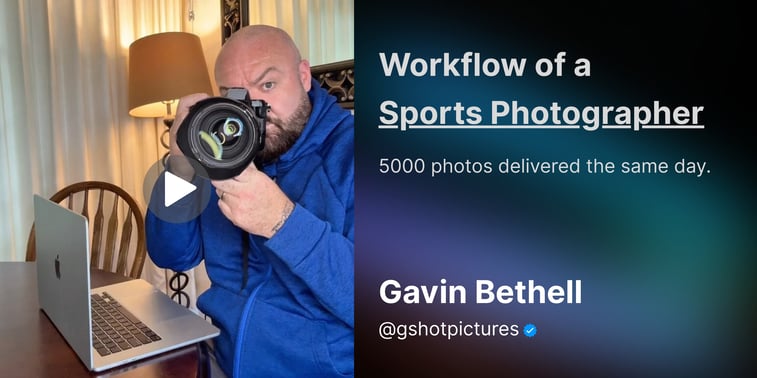
A youth tournament photographer Gavin shoots three games in a day, each with hundreds of parents waiting. By the time the last whistle blows, expectations are already set. Parents are refreshing galleries. Teams want highlights. Coaches want images for social posts that night.
The photographer knows something critical: once the next game starts, the previous one stops mattering. A goal photo delivered tomorrow isn’t late — it’s invisible.
Sports photographers don’t chase perfection. They chase relevance. Their workflow is designed to surface decisive moments quickly, not to endlessly debate which frame is technically superior. Speed protects meaning.
Concert photography lives in an even narrower window. Artists, promoters, and venues expect a handful of decisive images almost immediately—often before the artist leaves the venue. These photos fuel same-night posts, stories, and tour marketing. When delivery misses that window, the crowd energy is gone, and the images lose their emotional impact no matter how strong they are technically.
Mini case narrative:
In a concert pit, the photographer Christina often has a narrow shooting window. The artist may only allow photos for the first few songs. By the time the set ends, the expectation is already there: a handful of images, ready now.
Promoters and artists don’t want a full gallery. They want three or four images that capture the energy of the night & delivered while that energy still exists. If the photographer waits until morning, the moment has already passed. The crowd has moved on. The tour is on to the next city. Concert photographers learn quickly that delivery timing is part of the performance. Miss it, and the work loses its impact no matter how strong the images are.
School and volume photography operate under a different pressure entirely. Here, delivery unlocks an entire operational pipeline. Proofing systems, parent orders, administrative workflows, and revenue collection all depend on images arriving on time and correctly grouped. Slow delivery doesn’t just frustrate clients, it blocks the business from functioning.
.jpg?width=757&height=379&name=BLOG%20DRAFTS%20(24).jpg)
Mini case narrative:
A school photography company in Ohio shoots thousands of students across multiple days. Parents aren’t waiting for art — they’re waiting for access. Until images are delivered and correctly grouped, proofing can’t begin. Orders can’t be placed. Revenue can’t flow.
In this world, slow delivery isn’t just inconvenient. It blocks the entire business pipeline. Administrators start following up. Parents grow impatient. The photographer feels pressure not because of image quality, but because the system is stalled. School photographers don’t optimize for speed to impress clients. They optimize because delivery is the switch that turns the business on.
Special and tropical events operate under a different kind of deadline. Not a clock, but an expiration. Seasonal installations, destination activations, pop-up experiences, and once-a-year showcases exist briefly. Once the event is dismantled or attendees leave the location, attention collapses. Images delivered after that point don’t feel late — they feel disconnected.
.jpg?width=757&height=379&name=BLOG%20DRAFTS%20(16).jpg)
Mini case narrative:
At a large floral installation in Buckhead, Atlanta — an event that appears only once a year and stays open for only a few days — a photographer assembled a team on short notice. A model was booked. Hair and makeup were brought in. The shoot had to happen immediately.
Thousands of images were captured in a narrow window. The shooting was not the challenge. What followed was.
Culling traditionally takes hours, and in this case, hours didn’t exist. Every delay reduced the usefulness of the work. Once the installation came down, the photographs would lose the context that gave them meaning.
Instead of treating selection as a later task, the photographer closed decisions early using FilterPixel. Duplicate frames and near-identical moments were removed first, leaving a controlled, review-ready set while the shoot was still fresh.
With selection compressed, editing could happen immediately. Finished images were released the next day — while the installation was still live and the conversation around it was still active.
As with sports, concerts, and schools, speed here isn’t about efficiency for its own sake. It’s about relevance.
Once people leave the destination, the event stops existing. And when the event stops existing, the photography loses its role.
How High-Volume Photography Actually Works in Practice
Despite the differences between genres, the operational structure is remarkably similar. Most high-volume photographers are shooting solo or with small teams. Multiple cameras are in play. Cards are filling up continuously. Files are coming in faster than they can be reviewed. Assistants or editors, if they exist at all, are often remote and under the same time pressure.
There is rarely a clean separation between shooting and post-production. Shooting continues while files pile up. Fatigue sets in before culling even begins. Decisions that determine delivery success are often made at the point when mental clarity is weakest.
This is where many theoretical workflows fall apart. They assume time exists between steps. In reality, everything overlaps. The photographer is already tired when the hardest decisions begin.
What “Delivery” Means in High-Volume Work
Delivery is often misunderstood as a technical step. In high-volume photography, it is a business handoff.
For conference photographers, delivery means curated, branded selects that marketing teams can publish immediately. For sports photographers, it means decisive moments sorted and ready for distribution while the result still matters. For concert photographers, it means a small number of images that capture the energy of the night and arrive while that energy still exists. For school photographers, it means proof-ready, correctly structured sets that unlock purchasing workflows. For brands, it means clean, representative coverage that can be used in reporting and presentations without explanation.
In every case, delivery is not about volume. It’s about trust. The client needs to trust that what they receive is correct, complete, and aligned with why the photography was commissioned in the first place.
Slow Delivery Quietly Breaks Everything
When delivery slips, the damage is rarely dramatic. It’s structural.
Marketing teams miss publishing windows. Sports images lose relevance. Concert photos miss the emotional peak. School ordering pipelines stall. Brand reporting weakens. And photographers, regardless of image quality, are quietly labeled unreliable.
What makes this dangerous is that the failure doesn’t always feel like failure while it’s happening. It feels like caution. One more review pass. One more check. One more adjustment. But in high-volume work, hesitation compounds faster than mistakes.
The Real Pressure Points
Before software, before AI, before workflow diagrams, the pressure is human.
Multiple shooters make different choices. Assistants interpret moments differently than the lead photographer. Fatigue makes every decision feel heavier than the last. Fear creeps in—fear of missing something important, fear of delivering the wrong image, fear of being judged on a single mistake.
This is where deadlines are lost, not because people don’t care, but because too many decisions are being deferred until the worst possible moment.
Rethink the Workflow for Reality
Only once this reality is acknowledged does the workflow itself matter.
Ingest, cull, review, and deliver still exist, but their purpose changes. Ingest is no longer about organization; it’s about speed without creating future problems. Files need to move into a reviewable state quickly and cleanly, without unnecessary renaming or restructuring that adds cognitive load later.
Culling stops being about scoring images in isolation and becomes about making comparative decisions. High-volume culling works when similar images are seen together and one clear choice is made. The goal is not to find the perfect frame, but to confidently select a representative moment that holds up under scrutiny.
Review shifts from interrogation to validation. Photographers who deliver reliably review in passes. They check for consistency, confirm critical moments, and ensure nothing obvious is missing. They don’t re-litigate every decision because they trust the system that produced those decisions.
Delivery, when the workflow is right, becomes uneventful. Image counts are known. Standards are already met. Branding and structure are consistent. By the time files are exported, the hardest thinking has already happened.
.jpg?width=1350&height=270&name=BLOG%20DRAFTS%20(25).jpg)
Where AI Fits and Where It Doesn’t
AI enters this picture only after the ground rules are set. (See our best photo culling software comparison.) Used correctly, it reduces repetitive decision-making, groups patterns, and preserves judgment under fatigue. Used incorrectly, it creates false confidence and hides mistakes.
The strongest high-volume workflows treat AI as a support system, not an authority. Judgment remains human. Responsibility remains human. The load is simply shared so that decision quality doesn’t collapse under pressure.
The Shift That Changes Delivery
If delivery feels stressful, it’s usually because too much is still undecided. The mistake that most photographers in this space does is thinking that they’ll sort it out later.
But later is when you’re tired. Later is when every frame feels important, even the ones that aren’t. 45% of high-volume event photographers who deliver on time don’t trust later. They close things earlier, while the shoot is still fresh and their head is still clear. It’s actually asking yourself not to make your hardest decisions at the worst possible moment.
How FilterPixel Helps To Deliver High-Volume Work
One interesting thing is, high-volume events break photographers in the middle, not at the end. That stretch after the shoot, when the cards are full, the clock is moving, and you’re still expected to be sharp, is where most workflows fall apart. Not because the images are bad, but because there are too many of them and too little attention left.
FilterPixel is built for that exact stretch.
It works by narrowing the work instead of expanding it. By keeping similar moments together.
By helping you make comparative choices before fatigue turns everything into a debate.
That’s why it fits conferences, sports, schools, concerts, and any job where delivery isn’t optional. The goal isn’t to decide for you. It’s to make sure your decisions still hold up when the pressure does.
Start free. No credit card required.
Related Reading
Try FilterPixel on a real job. See what changes when the work stops growing and starts closing.
Frequently asked questions
What software enables same-day event photo delivery?
Same-day delivery is a culling problem more than an editing one — the shoot is bounded by the event, but manual selection is not. FilterPixel returns around 1,000 photos scored in roughly eight minutes with processing in the cloud, so speed does not depend on the laptop you carried in, and each frame carries a score and a written reason so you can confirm picks quickly rather than re-reviewing everything. Selects export to Lightroom Classic or Capture One for the edit pass.