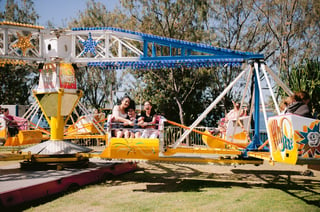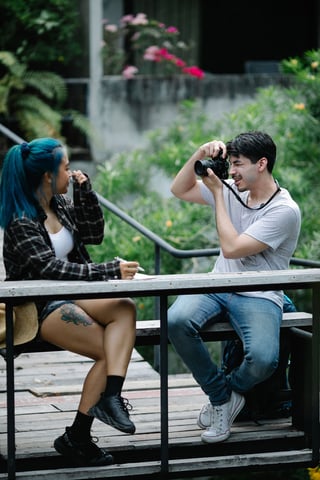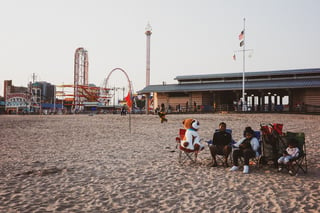

Your photographers shoot.
Roaming, character and green-screen points, as they work today.
FilterPixel keeps the best frame of every roaming, character and green-screen burst, with one consistent edit. Coming soon, in a 30-day pilot: photos are matched to each guest's ticket or wristband and put on their phone while the day is still happening.
Selection and editing run on DeepCull today. Guest matching and on-phone sales are coming soon, and run alongside your ride cameras and kiosks.
A theme park photography system captures guest photos around a park, links them to each guest and sells them as prints or digital downloads. It spans ride cameras, roaming and character photographers, green screen, kiosks and online stores. FilterPixel handles the steps most systems leave to people: choosing the best frame of every burst and getting it to the guest's phone before they leave.

A character meet. Twelve frames per family, two with blinks, four near-identical.
The family is told to find a kiosk later.
Tired kids and a long kiosk line. They skip it.
The best frame, edited and matched to their wristband, on their phone before the exit.

Roaming, character and green-screen points, as they work today.


Best of burst


Blinks, blur and near-duplicates dropped, with one consistent edit. Live today.
QR ticket, wristband or photo card by default. Coming soon.

Watermarked previews to buy before they leave. Coming soon.
Ride cameras fire a few fixed frames. Roaming and meet-and-greet photographers shoot bursts, and that's where automatic selection saves the most time.
Only with the right notice and consent. Illinois' Biometric Information Privacy Act and Texas' biometric identifier law require consent before biometric data is collected, and the GDPR treats biometric data used to identify people as special-category data. That's why FilterPixel links photos to a ticket, wristband or photo card by default, with selfie matching opt-in for adults only where you allow it. Check with your own counsel for each venue.
| Job | Ride camera and kiosk systems | Guest photo platforms | FilterPixel |
|---|---|---|---|
| Best frame of each burst | Not the focus: fixed frames | Not the focus | Picked automatically · live today |
| One edit across photographers | Not the focus | Varies | Consistent look every shift · live today |
| Match photos to guests | Photo card or kiosk lookup | QR, wristband, app or face matching | Ticket, wristband or card by default · coming soon |
| Guest buys before leaving | At the kiosk | Often, by app or link | On their phone · coming soon |
| Cameras, printers and kiosks | Core | Varies | Not needed · works with yours |
Ride camera and kiosk systems include Image Insight and System Insight. Guest photo platforms include Capturelife, Pixel Attractions and SP Photo Station, and large parks run their own programmes, such as Disney PhotoPass. Features vary by vendor and plan, so check each vendor's current documentation.
Groups photographed across the park in bursts of near-identical frames.
Queues of families, blinks and kids looking the other way.
Thousands of guests photographed across decks, dining and ports.
Santa and holiday photos with short buying windows.
Running conferences or corporate events? See live event photo sharing.
We run next to an existing photo point and measure it against a comparable one.
Most parks combine three things: ride cameras at the drop, roaming and character photographers around the park, and a kiosk or app where guests find their photos by code, wristband or ticket. Large programmes such as Disney PhotoPass put them all in one gallery. FilterPixel adds the selection step for burst-heavy photo points, and guest matching with on-phone sales is coming soon.
No. Ride cameras take a few fixed frames, so there is little to select. FilterPixel works alongside them and focuses on roaming photographers, character meet-and-greets, green screen and other burst-heavy photo points.
By default, photos are linked to a code the guest already has: a QR ticket, wristband or photo card. Opt-in selfie matching is available for adults where you choose to allow it.
It can be, with the right notice and consent. Illinois BIPA and Texas' biometric identifier law require consent before biometric data is collected, and GDPR treats biometric data used for identification as special-category data. That's why code-based matching is the default and selfie matching is opt-in for adults only.
Roaming photographers, character meet-and-greets, green screen and seasonal experiences, where photographers shoot bursts of near-identical frames and guests move on quickly.
Coming soon: guests scan their ticket, wristband or photo card, see watermarked previews on their phone and buy before they leave, through your store or ours.
No. Galleries open in the phone's browser from a QR code or link.
Yes. Ships photograph thousands of guests a day across decks, dining and ports, which is the volume selection is built for. Connectivity and matching are scoped per ship.
Photos upload as small preview files, which keeps working on busy park networks. Areas with no signal are scoped individually during the pilot.
Yes. Your logo and frames can be added to every photo, the same way FilterPixel adds sponsor branding at live events.
Per photo point or venue, as a share of the extra photo revenue measured in the pilot, or as a license for concessionaires running many venues. Terms are agreed in writing before the pilot.
We run alongside one existing photo point for 30 days and compare capture rate, purchase rate and order value with a similar point. Commercial terms are agreed before the pilot and tied to the results.
Attraction and cruise photo operators, park-run photo departments and concessionaires that run photography across many venues.
Updated 16 September 2026