FilterPixelVSAftershoot
The Definitive Comparison for Professional Photographers
Aftershoot was built for photographers who process after the shoot, at their own pace. FilterPixel was built for photographers who process during the event, at the venue, under time pressure. We tested both tools on the same 1,232 concert photos, on the same machine, and measured everything. This is what we found.
Try DeepCull Free2,000 photos free · No credit card required
Aftershoot Was Built For A Different Photographer
Aftershoot's brand is built on "reclaim your time" and "work life balance." That resonates with wedding photographers who cull on Tuesday evenings and deliver next week. But if your workflow is measured in minutes, filing from the press box at halftime, delivering before the encore, running the slideshow by cocktail hour, "reclaim your time" misses the point entirely. You are not trying to reclaim time. You are trying to deliver before the moment expires.
Feature-by-Feature Comparison
| Feature | FilterPixel | Aftershoot |
|---|---|---|
| AI culling model | Genre specific modes (sports, concert, conference, wedding) each trained on distinct quality signals | General aesthetic model applied across all shoot types. Genre dropdown exists but scoring is predominantly portrait and wedding trained |
| Culling modes | Basic Cull (customizable sliders) plus DeepCull (genre specific intelligence, no manual tuning needed) | Automated AI Cull (slider from Extreme to More) plus Customized AI Cull (toggle detections for blur and closed eyes) |
| Transparency | AI Analysis score out of 10 on every thumbnail with expandable reasoning panel showing exactly why | Star ratings and category labels with no per image reasoning available |
| Processing | Cloud GPU delivers the same speed on a venue laptop as a studio workstation | Desktop local processing where speed depends entirely on your hardware |
| Platform | Windows, macOS, and cloud via desktop app | Windows and macOS desktop app only |
| System requirements | Minimal specs needed because cloud handles the heavy processing | Requires powerful hardware with significant RAM and storage for high volume shoots |
| Speed (1,232 concert photos) | 5 min 28 sec at 0.27 sec per photo | 18 min 19 sec on the same machine |
| Magic Number | Type the exact number of selects you need and AI ranks by genre intelligence | No equivalent feature. Fine Tune slider moves between Extreme and More |
| AI editing | AI Profiles (community and built in) with RAW and COLOR modes, plus Crop, Straighten, and Tone Curve | AI editing plus retouching with 30+ marketplace styles, personal AI profiles, blemish and wrinkle tools |
| Custom AI profiles | ✓ | ✓ |
| Offline capability | Requires internet connection | Full offline processing available |
| Lightroom integration | XMP sidecar export | XMP sidecar export |
| Free tier | 4 projects free forever plus 1 DeepCull project free | Free trial only |
Speed Comparison
How fast can each tool cull real-world shoot sizes?
| Metric | FilterPixel DeepCull (Cloud) | Aftershoot (Same Machine, Local) |
|---|---|---|
| 1,232 concert photos | 5 min 28 sec | 18 min 19 sec |
| Per photo speed | 0.27 sec/photo | 0.89 sec/photo |
| On venue laptop | Same speed as studio workstation | Significantly slower than studio |
| Hardware dependency | None. Cloud GPU handles everything | High. Needs powerful CPU and RAM |
Interface Comparison: FilterPixel vs Aftershoot
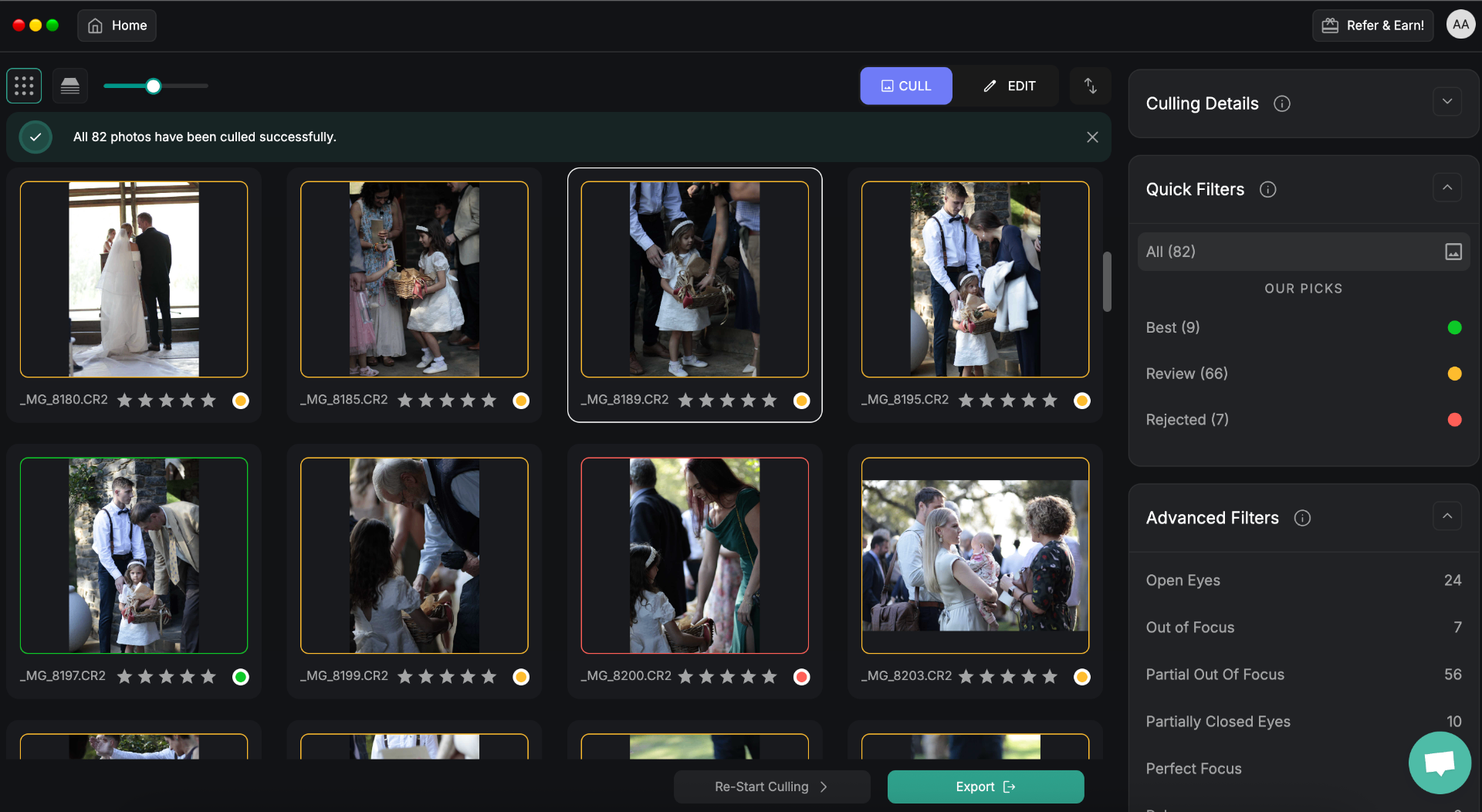
- AI Analysis score (out of 10) visible on every thumbnail at a glance
- Expandable Score+Reason panel explains exactly why each photo was selected or rejected
- Genre specific mode selector lets you choose Sports, Concert, Conference, or Wedding
- Magic Number input where you type exactly how many selects you need
- Cloud processing status indicator showing progress without local hardware strain
- Survey Mode for rapid grid review with AI scores overlaid on every frame
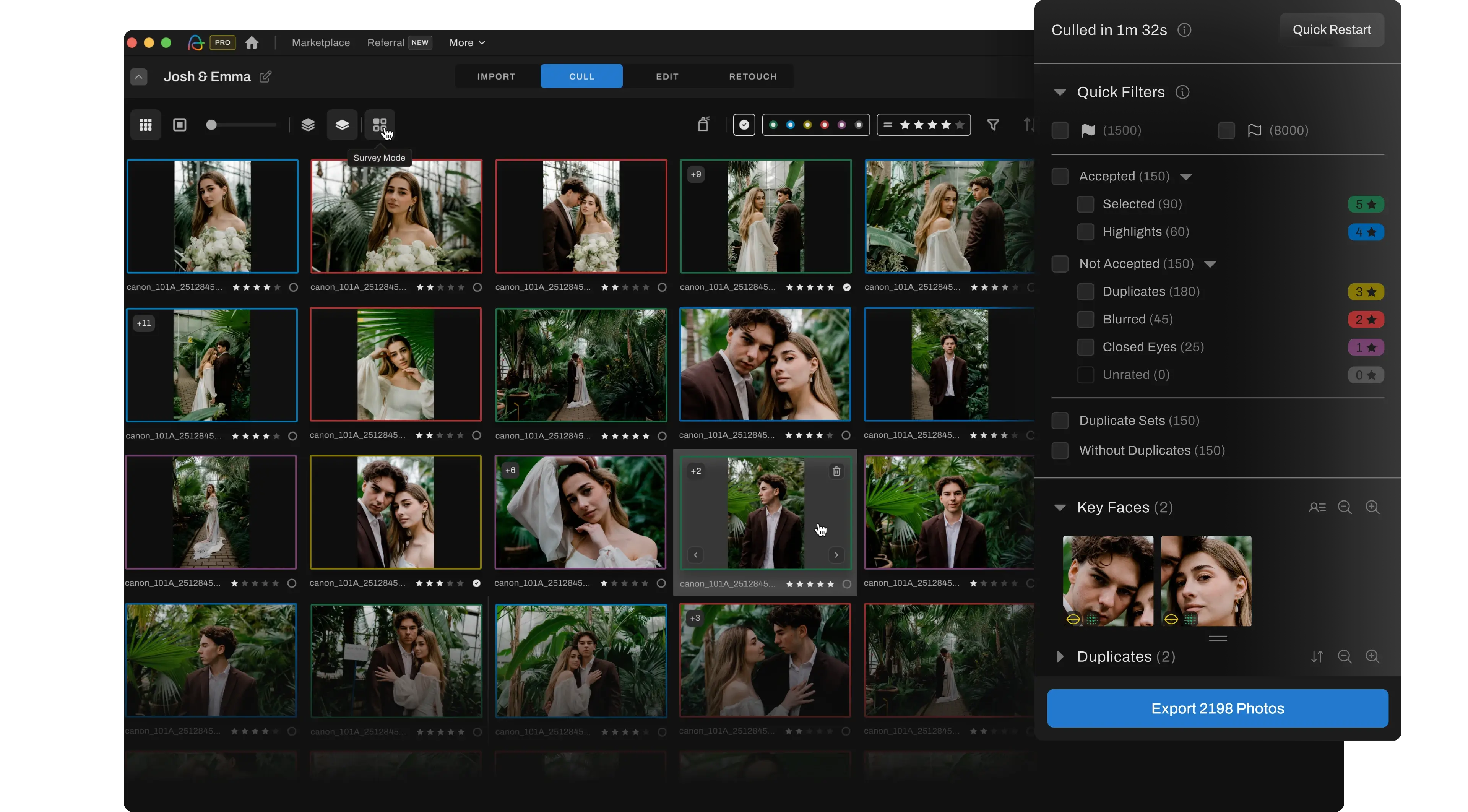
- Four tab pipeline covering Import, Cull, Edit, and Retouch stages
- Star ratings from 1 to 5 with color coded bars but no per image reasoning
- Key Faces panel for identifying and tracking people across the entire shoot
- Duplicates panel with count badges for burst grouping and review
- Local processing where speed is determined entirely by your hardware specs
- AI Cull slider from Extreme to More without genre specific scoring modes
Workflow Comparison
Pros & Cons
- 75% faster than Aftershoot at 161 versus 92 images per minute
- Processes 38% more images in less total time
- Genre specific AI models trained separately for sports, concerts, conferences, and weddings
- Magic Number lets you type exactly how many selects you need
- Cloud processing keeps your local machine completely responsive
- Score+Reason transparency shows the reasoning behind every single photo score
- Permanent free tier with 4 projects and no credit card required
- Requires internet connection for AI processing
- No auto retouch feature available yet
- Full offline culling and editing capability for locations without internet
- Portrait retouch module with blemish, wrinkle, and teeth adjustments
- 30+ marketplace editing styles to choose from
- 75% slower than FilterPixel at 92 versus 161 images per minute
- Heavy CPU and RAM usage causes system slowdown during processing
- No genre specific AI models for sports, concerts, or conferences
- No scoring transparency. Stars only with no reasoning provided
- More expensive for culling plus editing at $480/yr versus $180/yr
- Processing performance varies dramatically based on hardware specs
- System can become unresponsive during large batch processing
Where Aftershoot Falls Short: Genre Blind AI
Aftershoot applies a general aesthetic scoring model across all shoot types. Here is why that matters.
Aftershoot offers genre selection through a dropdown in its Set Preferences dialog: portrait, wedding, events. But the underlying AI is trained predominantly on wedding and portrait quality signals like sharpness, exposure, composition, and facial expression in controlled lighting.
If you’re weighing the wider field rather than just these two, we’ve compared the main Aftershoot alternatives for high-volume photographers.
Within that preferences dialog, Aftershoot gives you two culling modes. Automated AI Cull lets you move a slider between Extreme, Few, Standard, and More. Customized AI Cull lets you toggle individual detections like Blurry Photos, Closed Eyes, and Duplicate grouping. These are useful controls, but they are all technical quality filters. None of them understand what is actually happening in the frame.
When this model encounters sports action, concert stage lighting, or conference keynotes, it defaults to technical quality scoring. The result: Aftershoot picks the sharpest images but misses the storytelling moments that define a great event photo.
A festival photographer we interviewed described this precisely. After using Aftershoot on high volume events, he scrapped the entire AI selection and started from scratch. The AI chose technically sharp images but missed every emotional and narrative frame. His words: it was missing "that storytelling piece."
FilterPixel's DeepCull takes a fundamentally different approach. When you import photos, you select your shoot type from a genre dropdown: Corporate Events, Sports, Concerts, and more. The AI loads a model trained specifically for that genre with distinct quality signals for each one. The AI does not just know if a photo is sharp. It knows if a photo is the moment.
Is Aftershoot Good for Sports Photography?
Aftershoot's general model struggles with sports because peak action and technical sharpness are fundamentally different signals. A player at the apex of a jump shot might have slight motion on the trailing arm. Aftershoot downgrades it. The frame one second later where the player is standing still scores higher on sharpness but misses the decisive moment entirely.
Sports photography has a specific quality hierarchy: peak action first, then composition, then technical sharpness. Aftershoot's model inverts this priority. DeepCull's sports mode is trained on this exact hierarchy with peak action detection, fast moving subject quality, and decisive moment timing.
Does Aftershoot Work for Concert Photography?
Stage lighting with LEDs, spotlights, smoke haze, and color washes produces images that a general AI reads as underexposed, color shifted, or low contrast. These are not flaws. They are the aesthetic that makes concert photography powerful.
Aftershoot frequently downgrades the most atmospheric concert frames because the AI interprets stage lighting as technical problems. Your selects end up full of cleanly lit soundcheck photos while the performance peaks sit in the For Review tab waiting to be rescued.
DeepCull's concert mode is trained to assess stage lighting as an intended condition, not a defect. Our test with 1,232 concert photos showed DeepCull consistently selecting the high energy performance frames that Aftershoot had flagged as uncertain.
Culling Speed and Accuracy: Real Test Results
When you have 15 minutes at halftime, you cannot afford to second guess 80 AI selections one by one.
Aftershoot delivers a culling result as a binary decision: keep or reject. After culling, you see images sorted into AI Selections (Selected with 5 stars, Highlights with 4 stars), Duplicates groups, and Unrated images. The review interface is well designed with a solid single image review mode, a Key Faces panel, filmstrip with color coded bars, and a Duplicates panel with count badges. It is a clean, professional interface.
But there is no explanation for why a photo was selected or passed over. You see stars and colors, but not the reasoning behind any decision.
DeepCull delivers a score and explicit reason for every single photo. In Survey Mode, every image displays an AI Analysis score out of 10 right on the thumbnail. Click into any image and the AI Analysis panel expands with full context:
Score 9.2 Peak action moment. Subject at apex of jump. Sharp on primary subject. Strong background separation.
Score 6.8 Motion blur on primary subject. Duplicate of frame #3201 (scored 87). Burst grouping: inferior frame.
This transparency is not a luxury feature. It is the difference between trusting your AI at halftime and spending 30 minutes re reviewing after the event wondering if you missed the money shot.
Cloud Processing vs Desktop Local: Why It Matters at the Venue
At the venue, the equation changes completely.
Aftershoot processes photos on your computer. At your studio on a high spec iMac or MacBook Pro, this works perfectly well. At the venue, everything changes.
A sports photographer in the press box is working on whatever laptop fits in their bag. A conference photographer is processing between sessions on a travel machine. A wedding photographer delivering the cocktail hour slideshow is working on whatever hardware happens to be available.
Desktop local processing means your deadline speed is constrained by the weakest machine you bring to the field. Aftershoot requires powerful hardware with significant RAM and storage to handle high volume shoots efficiently. On a lighter laptop, processing times can double or triple.
We tested both tools on the same set of 1,232 concert photos on the same machine. Aftershoot took 18 minutes and 19 seconds. FilterPixel processed the same images in 5 minutes and 28 seconds through the cloud at roughly 0.27 seconds per photo. That is more than 3x faster, and the gap widens on weaker hardware because FilterPixel's speed does not depend on your laptop at all.
DeepCull processes everything in the cloud. The MacBook Air in the press box delivers the same culling speed as the studio workstation. Your hardware stops being a deadline bottleneck entirely.
Aftershoot Has No Deadline Specific Workflow
Aftershoot was designed for photographers who process after the shoot, in their studio, at their own pace. The UI and feature set reflect this philosophy and to be fair, that post event workflow is polished. The four tab pipeline (Import, Cull, Edit, Retouch) includes AI retouching with controls for blemish removal, wrinkle reduction, and teeth adjustments. The Marketplace offers 30+ pre built editing styles. For photographers who want one tool for their entire post production workflow, this is a legitimate time saver.
But none of this helps you when you need to deliver photos the same day.
FilterPixel gives you two culling modes designed for different situations:
- Basic Cull is your everyday workhorse. It selects the best shots from similar frames, tags blur and blinks, and gives you customizable sliders for Duplicate grouping, Blinks detection, and Focus Quality.
- DeepCull is purpose built for deadline photographers. When you select it, the card reads: "Concerts Specific Culling. Trained on millions of Concerts photos. Reliable for professionals delivering under pressure." DeepCull analyzes the entire shoot holistically, understands the arc of the event, and picks photos based on both technicality and storytelling.
Pair either mode with Magic Number. Type the exact number of photos you need, say 10 out of 1,232, and the AI selects exactly that many. The quality ranking depends on which mode you use. Basic Cull ranks by technical signals. DeepCull ranks by genre intelligence, factoring in storytelling value, peak action, and emotional impact.
Pricing Comparison (Verified June 2026)
Aftershoot Plans (2026)
Aftershoot now sells individual workflow modules or a complete bundle:
- Select (culling only) at $120 per year. Includes AI image selections, smart duplicates grouping, and key faces detection.
- Edit (editing only) at $360 per year. Includes professional AI profiles, 30+ pre built marketplace styles, AI crop, straighten, and masking.
- Retouch (retouching only) at $240 per year. Includes AI portrait retouching, custom retouching presets, and batch sync.
- Complete (everything bundled) at $540 per year, saving 25% versus buying separately. Includes all features from Select, Edit, and Retouch.
FilterPixel Plans (2026)
- Free at $0 per month, forever. 4 projects with unlimited culling, unlimited photos per project, blur and closed eyes tagging. No credit card required.
- Standard at $14.99 per month (billed annually at $180 per year). Unlimited projects, 20 DeepCull shoots per year, all genre modes, Score+Reason on every photo, AI editing with built in profiles.
- Pro at $34.99 per month (billed annually at $420 per year). Everything in Standard plus 70 DeepCull shoots per year, Magic Number, JPEG export for same night delivery, and 2 custom trainable AI profiles.
- Studio at $64.99 per month (billed annually at $780 per year). Everything in Pro plus 140 DeepCull shoots per year, 5 custom trainable AI profiles, up to 5 team seats, team usage dashboard, and VIP support.
The Honest Price Comparison
| What You Need | FilterPixel | Aftershoot |
|---|---|---|
| AI culling only | Free (4 projects) or $180/yr Standard | $120/yr Select |
| Culling plus editing | $180/yr Standard (includes AI editing) | $480/yr (Select + Edit separately) |
| Culling plus editing plus retouch | No retouch module available | $540/yr Complete bundle |
| Genre specific DeepCull | $180/yr with 20 shoots included | No equivalent at any price |
| Free tier | 4 projects free forever | Free trial only |
The bottom line on pricing: FilterPixel's Standard plan at $180 per year includes both AI culling and AI editing with genre specific DeepCull. That is comparable to Aftershoot's Select plus Edit bundle at $480 per year but at 63% less cost. Aftershoot wins if you need portrait retouching, which FilterPixel does not offer yet.
Switch to FilterPixel DeepCull If
- You regularly re review Aftershoot's selections because the AI misses the moments that matter in your genre
- You shoot sports, concerts, conferences, or deadline weddings where filing happens during the event, not days later
- You need to cull at the venue on whatever laptop is available and hardware speed is holding you back
- You need Score+Reason transparency to trust AI selections under time pressure without manually checking every frame
- You deliver to clients, editors, or sponsors with hard deadlines measured in minutes or hours, not days
Stay With Aftershoot If
- You primarily shoot wedding and portrait photography with multi day or multi week turnaround times
- You want AI editing, culling, and retouching in a single application with access to 30+ marketplace profiles
- You are genuinely satisfied with Aftershoot's selections in your genre and never feel the need to re review
- You frequently work in venues with unreliable internet where Aftershoot's offline first architecture is a genuine advantage
- You value having portrait retouching built in with blemish, wrinkle, and teeth adjustment tools
The Honest Assessment: Consider Using Both
Not every Aftershoot user should switch. These are two genuinely different tools built for different photographer workflows. Some photographers get the best results by using both:
- You shoot both deadline events like sports and concerts and relaxed sessions like portraits and personal projects
- You want Aftershoot's editing and retouching capabilities but need DeepCull's genre specific culling intelligence when the clock is ticking
- You are testing DeepCull on your most time sensitive shoots while keeping Aftershoot for your regular studio workflow
This comparison is not about declaring one tool universally better. It is about understanding which tool was built for the job you need done today.
What Photographers Say
“After using Aftershoot on high volume events, I scrapped the entire selection and started from scratch. The AI chose technically sharp images but missed every emotional and narrative frame. DeepCull gets that storytelling piece that makes event photography worth delivering.”
“In the press box at halftime, I need to trust the AI picks without re reviewing every single frame. DeepCull's Score+Reason tells me exactly why each photo was chosen. Aftershoot just gave me stars with no explanation.”
“5 minutes versus 18 minutes for the same 1,232 photos. On a venue laptop, that is the difference between delivering before the encore and missing the deadline entirely. Cloud processing changed everything for my concert workflow.”